X-Sudoku (Diagonal Sudoku): Rules & How to Solve
The diagonal sudoku rule explained: both main diagonals must also hold 1–9. How X-sudoku differs from classic sudoku, plus the techniques that crack it.
The rule
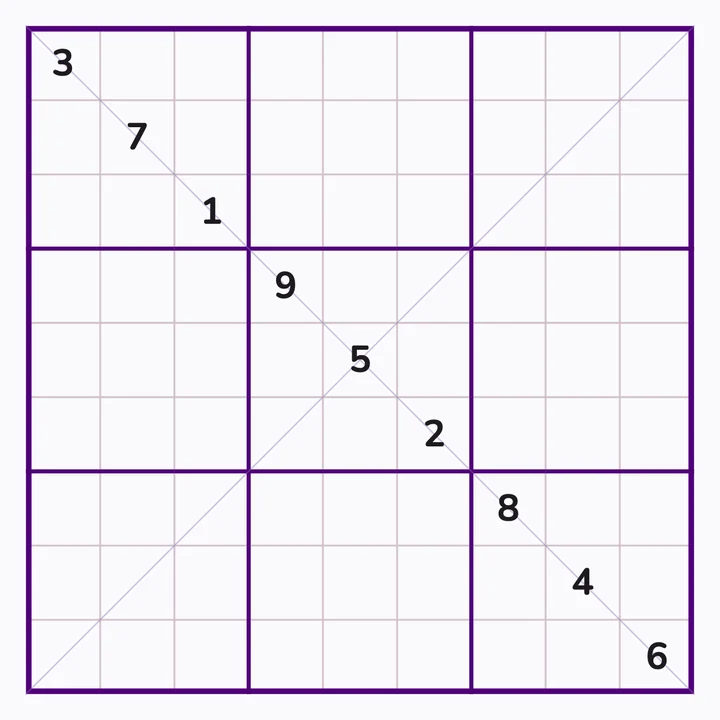
In addition to the normal rules, each of the two main diagonals must also contain the digits 1–9 exactly once.
Does normal sudoku work diagonally?
No — and this is the single most common misunderstanding about sudoku. In classic sudoku the diagonals mean nothing: a digit may repeat along a diagonal, and a correct solution will very often do so. The only regions that must hold 1–9 are the nine rows, nine columns and nine boxes.
Diagonal sudoku — also called X-sudoku — is a variant that bolts one extra rule on top: the two main diagonals each become a tenth and eleventh region that must also hold 1–9 exactly once. If a grid does not say it is a diagonal or X-sudoku, assume the diagonals are unconstrained.
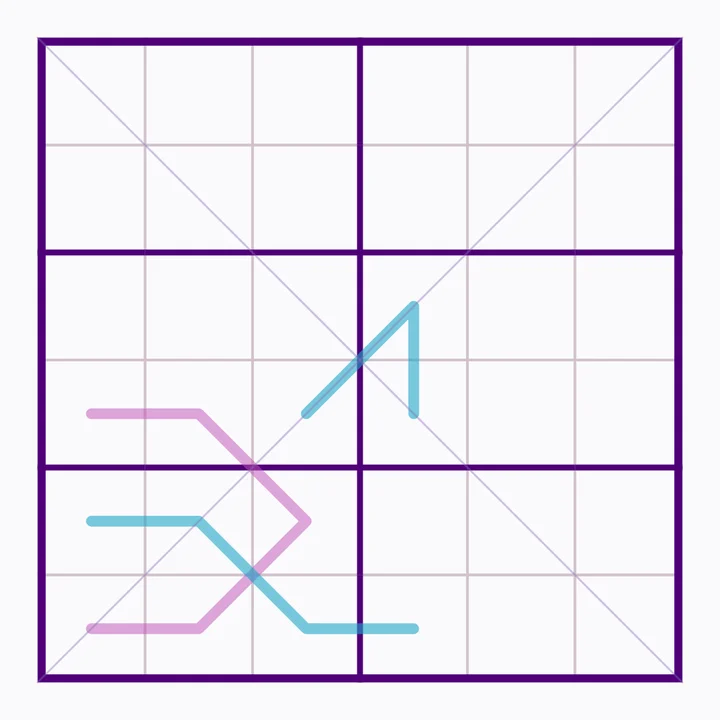
Only the two main (corner-to-corner) diagonals are constrained. Shorter, broken diagonals elsewhere in the grid carry no rule.
How to solve diagonal sudoku
Treat each diagonal as an extra region
The two diagonals behave exactly like rows and columns: nine cells, digits 1–9, no repeats. Every scanning technique you already use — hidden singles, naked pairs, pointing candidates — works on a diagonal unchanged. The habit to build is simply remembering to look: most X-sudoku mistakes are ordinary deductions that were never attempted because the solver only scanned rows, columns and boxes.
The centre cell does double duty
Both diagonals cross at r5c5, so that one cell belongs to a row, a column, a box and two diagonals — five regions at once, more than any other cell in the grid. Whatever you place there eliminates a candidate from sixteen other diagonal cells immediately, which is why solving the centre early tends to cascade.
Only five boxes touch a diagonal
Each diagonal passes through exactly three boxes, three cells at a time: the two corner boxes and the centre. Taken together the diagonals touch only boxes 1, 3, 5, 7 and 9 — the four edge boxes contain no diagonal cells at all. That asymmetry is useful in both directions: deductions propagate fastest through the corner and centre boxes, and when you are stuck there, the edge boxes are pure classic sudoku.
The centre box is half diagonal
Five of the centre box's nine cells sit on a diagonal — the three on each diagonal, sharing r5c5. Only r4c5, r5c4, r5c6 and r6c5 are free of diagonal constraints. When the centre box is heavily clued, those four cells are usually where the remaining freedom lives.
Apply the 45 rule to a diagonal
A diagonal holds 1–9, so it sums to 45. If you know eight of its nine cells, the ninth is forced by subtraction — and more usefully, if a diagonal's three cells inside one box are known to total T, the remaining six cells must total 45 − T. This pairs well with killer-style arithmetic when a puzzle combines both constraints.
Step by step: techniques from the hint engine
Each example is drawn the way VariantDoku's hints show it: red candidates are eliminated, blue ones are what the step proves, and green cells are solved.
Hidden singles on a diagonal
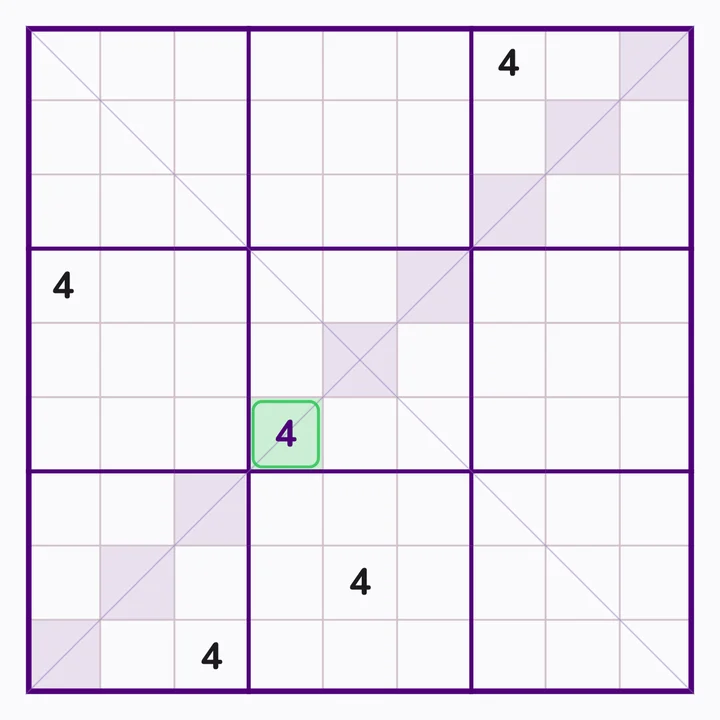
Scan each diagonal as you would a row: for every digit, ask where on the diagonal it can still go. Here the four given 4s rule out every anti-diagonal cell but one — three sit in the top-right box with a 4, three in the bottom-left box with a 4, one shares a row with a 4 and one shares a column with a 4. The last cell must hold the diagonal's 4, a placement classic sudoku would never find.
On 4×4 and 6×6 boards
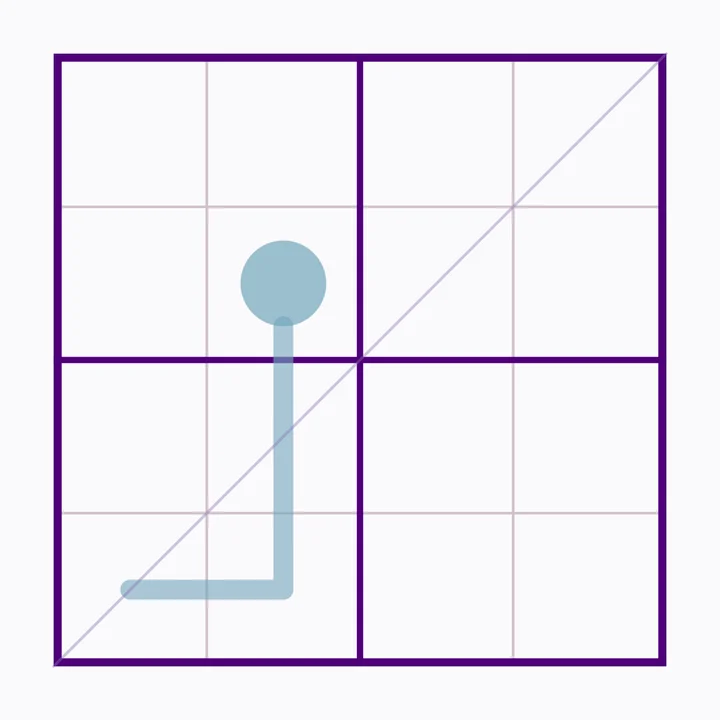
VariantDoku's 4×4 and 6×6 puzzles use marked diagonals: digits may not repeat along any diagonal line drawn in the grid. A marked diagonal running corner to corner holds 1–4 exactly once on a 4×4 board and 1–6 on a 6×6 board, so it works as an extra region with hidden singles of its own. A shorter diagonal only forbids repeats — treat it like a cage without a total.
Try one from the catalog
Real VariantDoku puzzles with this rule. Each one opens in the app.
Frequently asked questions
What is X-sudoku?
A sudoku where the two main diagonals must also each contain 1–9, named for the X the diagonals form.
Is diagonal sudoku harder than classic?
Slightly — the extra constraints usually make it faster once you remember to scan the diagonals.
Do both diagonals have the rule?
Yes, both the top-left-to-bottom-right and top-right-to-bottom-left diagonals.
Does normal sudoku work diagonally?
No. In classic sudoku only rows, columns and 3×3 boxes must contain 1–9; digits are free to repeat along a diagonal. The diagonal rule applies only in diagonal sudoku (X-sudoku), and only to the two main corner-to-corner diagonals.
What is the diagonal sudoku rule?
Normal sudoku rules apply, and in addition each of the two main diagonals must contain the digits 1–9 exactly once, with no repeats.
Which boxes do the diagonals pass through?
Only the four corner boxes and the centre box. Each diagonal crosses three boxes, three cells at a time; the four edge boxes contain no diagonal cells.
Play X-Sudoku (Diagonal Sudoku) in VariantDoku
VariantDoku has a logic-checked catalog of X-Sudoku (Diagonal Sudoku) and dozens of other variants on 4×4, 6×6 and 9×9 boards, with new 4×4 and 6×6 dailies every day. Free on iPhone, iPad and Android — no ads, no trackers.