Kropki Sudoku: Rules & How to Solve
Kropki is Polish for "dots". A white dot marks consecutive digits, a black dot a 1:2 ratio — here are the rules and the techniques that crack them.
The rule
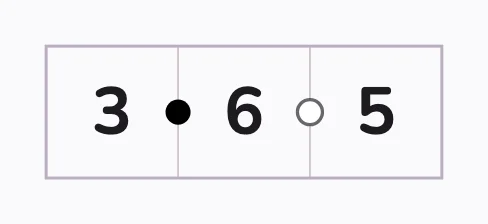
A white dot between two cells means the digits are consecutive (differ by 1). A black dot means one digit is double the other. Note that not every qualifying pair is necessarily marked, so check each puzzle's rules.
What does “kropki” mean?
Kropki is simply the Polish word for dots — singular kropka. The variant takes its name from its only visual ingredient: the small circles printed on the edges between neighbouring cells. You will also see it written as Kropki dots, dot sudoku, or, when only the white dots are used, consecutive sudoku.
Dots sit on the edge between two orthogonally adjacent cells, never on a corner and never between diagonal neighbours.
How to solve kropki sudoku
Black dots are the strongest clue on the board
Only four pairs of digits from 1–9 stand in a 1:2 ratio: {1,2}, {2,4}, {3,6} and {4,8}. A single black dot therefore cuts both cells down to at most four candidates each, and immediately rules out 5, 7 and 9 from both — those three digits can never touch a black dot. Always resolve black dots before white ones.
Black-dot chains collapse fast
Two black dots in a row are far more restrictive than one. When the three cells also share a row, column or box — so no digit can repeat among them — the chain must read 1–2–4 or 2–4–8 in one direction or the other, and a four-cell chain is forced to 1–2–4–8. Where the chain wanders across regions it can fold back on itself (2–1–2, 4–8–4), so check the geometry before collapsing it.
Chains of white dots behave like renban lines
A run of white dots means every step moves by exactly one. When the cells of the run share a row, column or box, no digit can repeat, so the run becomes a block of consecutive digits — a short renban line without a fixed direction. Length then does the work: a five-cell run must span a window of five consecutive digits, so its lowest cell is at most 5 and its highest at least 5. A run that crosses between regions may zigzag instead (3–4–3–4), which constrains far less — confirm the cells share a region before treating a run as a renban.
Watch the 1–2 overlap
The pair {1,2} is the one case that satisfies both rules at once: 1 and 2 are consecutive and also differ by a factor of two. Either colour of dot can legally mark it, so a white dot never fully rules out {1,2} and neither does a black one. Setters usually state which convention they follow — read the rules before leaning on that elimination.
Use the absence of a dot carefully
When a puzzle states that all dots are given, an empty edge is itself a clue: those two neighbours are neither consecutive nor in a 1:2 ratio, which is often enough to break a pair. When the puzzle does not make that promise — as in VariantDoku's catalog — a missing dot means nothing at all, and treating it as information will send you down a false line.
Step by step: techniques from the hint engine
Each example is drawn the way VariantDoku's hints show it: red candidates are eliminated, blue ones are what the step proves, and green cells are solved.
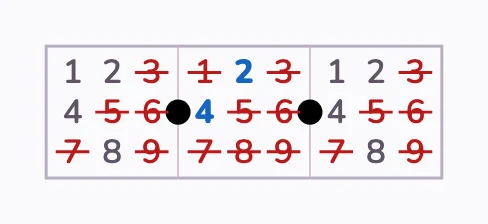
Two black dots in a row
A cell between two black dots must be double or half of both neighbours. In one row no digit repeats, so the middle cell needs two different 1:2 partners — and only 2 (partners 1 and 4) and 4 (partners 2 and 8) have two. The middle cell is 2 or 4, and the end cells come from 1, 2, 4 and 8.
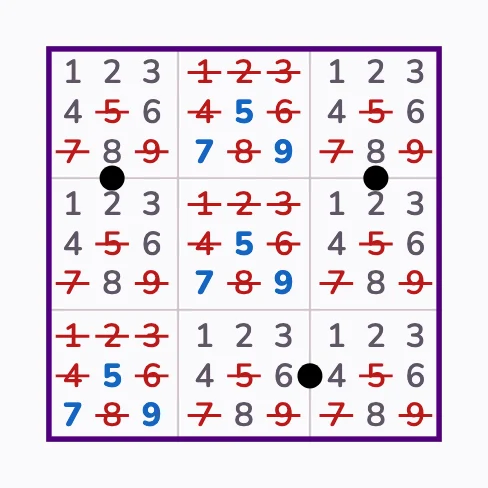
Three black dots in one box
Only four pairs fit a black dot: {1,2}, {2,4}, {3,6} and {4,8}. Three separate black dots in one box need three pairs with no digit in common, and the only such choice is {1,2}, {3,6} and {4,8}. Those six digits are locked onto the dots, so the box's other three cells must be 5, 7 and 9.
On 4×4 and 6×6 boards
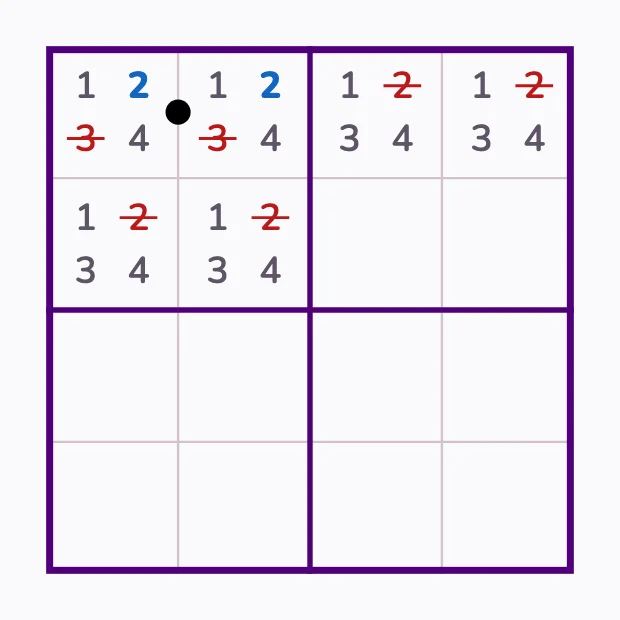
On a 4×4 board the black-dot pairs shrink to {1,2} and {2,4}: every black dot contains a 2, so 2 leaves every other cell of the dot's row, column or box, and 3 can never touch a black dot. On a 6×6 board the pairs are {1,2}, {2,4} and {3,6}, so 5 never touches a black dot, and a black dot that cannot be {3,6} must contain a 2.
| Board | Black-dot pairs | Never on a black dot | White-dot pairs |
|---|---|---|---|
| 4×4 | {1,2} {2,4} | 3 | {1,2} {2,3} {3,4} |
| 6×6 | {1,2} {2,4} {3,6} | 5 | {1,2} {2,3} {3,4} {4,5} {5,6} |
Try one from the catalog
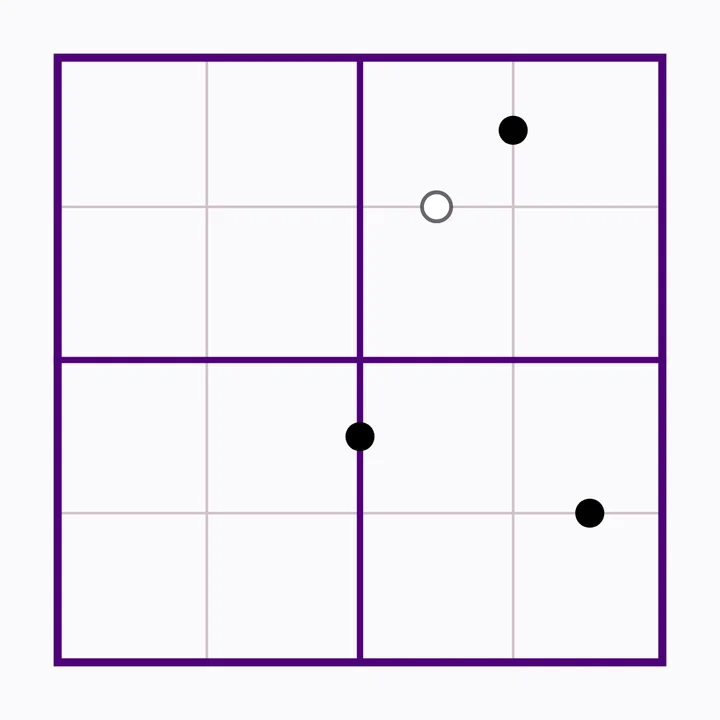
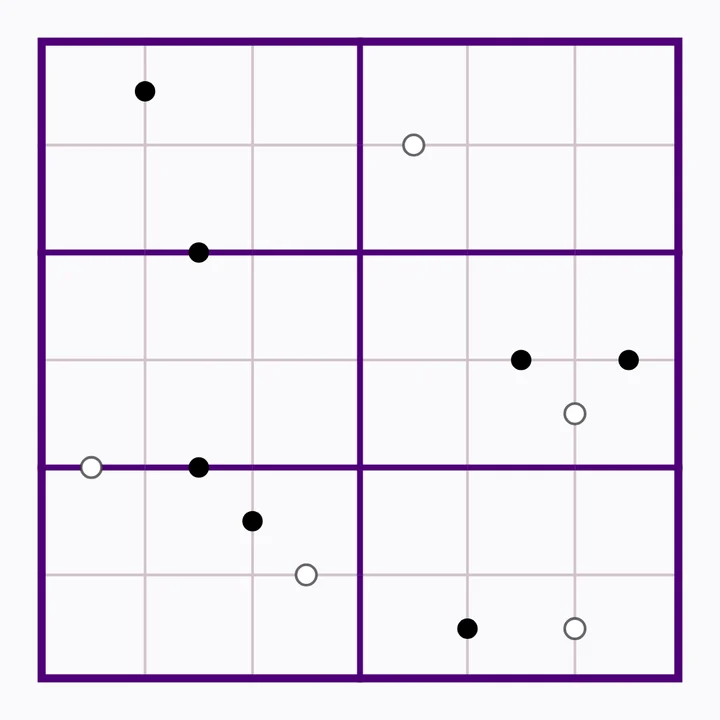
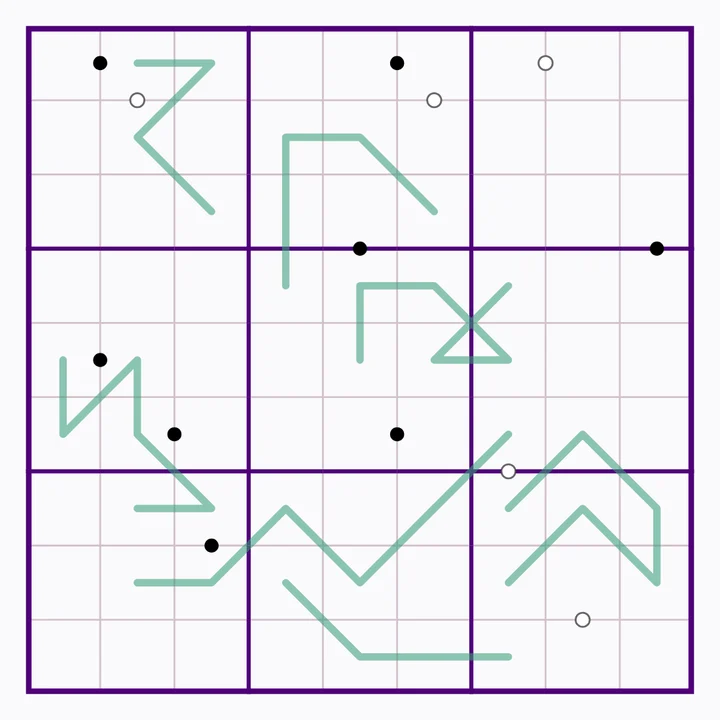
Real VariantDoku puzzles with this rule. Each one opens in the app.
Frequently asked questions
What does a white dot mean in Kropki sudoku?
The two cells it sits between hold consecutive digits, such as 4 and 5.
What does a black dot mean?
One cell is exactly double the other — {1,2}, {2,4}, {3,6}, or {4,8}.
What does kropki mean?
Kropki is Polish for “dots” (singular: kropka). The variant is named after the small dots printed between neighbouring cells, which are its only clue type.
Can 1 and 2 have a white or a black dot?
Both are valid. 1 and 2 are consecutive and also sit in a 1:2 ratio, so the pair satisfies either rule. Most setters state which dot they use for it, so check the puzzle's rules before ruling {1,2} out.
Which digits can never touch a black dot?
5, 7 and 9. The only 1:2 pairs available in 1–9 are {1,2}, {2,4}, {3,6} and {4,8}, and none of them contains 5, 7 or 9.
Are all Kropki dots always given?
Not necessarily. Many puzzles, including VariantDoku's, note when dots may be omitted, so don't assume a missing dot rules a relationship out unless stated.
Play Kropki Sudoku in VariantDoku
VariantDoku has a logic-checked catalog of Kropki Sudoku and dozens of other variants on 4×4, 6×6 and 9×9 boards, with new 4×4 and 6×6 dailies every day. Free on iPhone, iPad and Android — no ads, no trackers.