Killer Sudoku: Rules & How to Solve
Cages with target sums turn classic sudoku into an arithmetic puzzle. Here's the rule and the techniques that crack it.
The rule
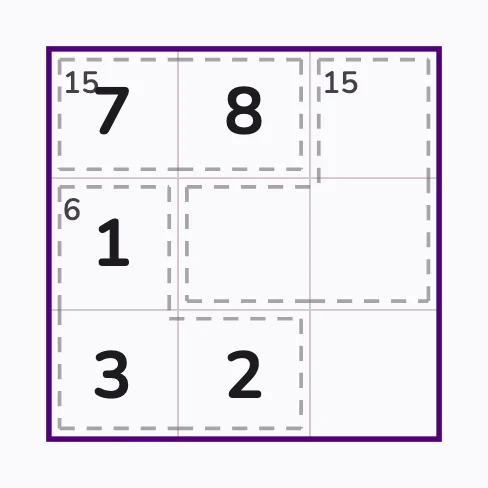
Digits inside a dotted cage must add up to the small number printed in its top-left corner, and a digit can't repeat within a single cage. Normal sudoku rules still apply: 1–9 once per row, column, and box.
How to solve killer sudoku
The 45 rule
Every row, column, and 3×3 box totals 45. If cages cover a box and spill out by one cell, you can solve that cell by subtracting the cage sums from 45.
Lock small cages first
A two-cell cage summing to 3 can only be {1,2}; a sum of 17 can only be {8,9}. These "killer pairs" eliminate candidates from the whole row, column, or box.
No repeats inside a cage
Even when several combinations fit a sum, the no-repeat rule often rules most of them out — a 3-cell cage of 7 is {1,2,4}, never {1,3,3}.
Step by step: techniques from the hint engine
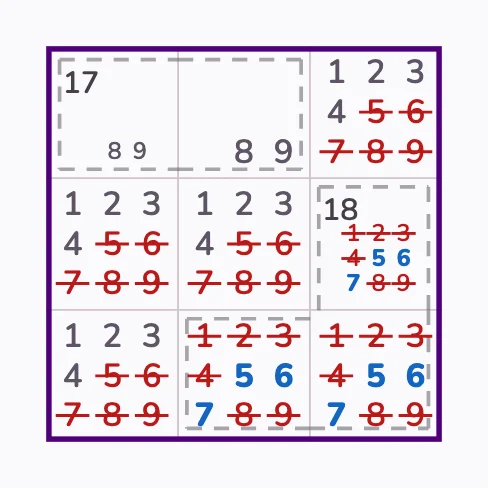
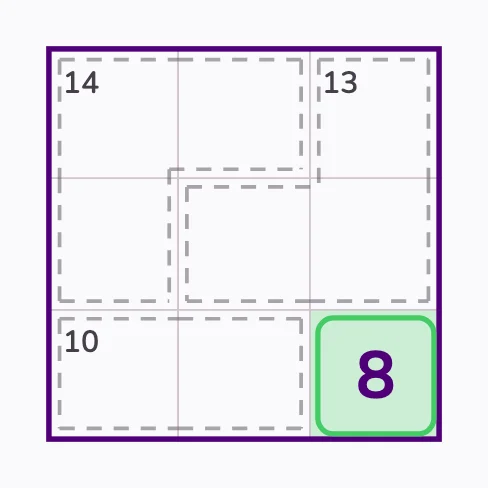
Each example is drawn the way VariantDoku's hints show it: red candidates are eliminated, blue ones are what the step proves, and green cells are solved.
Combine cages that share a box
List the digit sets each cage allows, then delete the sets that clash with the cages around it. The 17-cage can only be {8,9}. The 18-cage sits in the same box, so it cannot use 8 or 9 — and of its seven combinations ({1,8,9}, {2,7,9}, {3,6,9}, {3,7,8}, {4,5,9}, {4,6,8} and {5,6,7}) only {5,6,7} avoids both. That leaves exactly {1,2,3,4} for the box's four uncaged cells.
The 45 rule: find the innie
A box holds 1–9 once, so its nine cells always total 45. Three cages cover eight of this box's cells and add up to 14 + 13 + 10 = 37, so the one cell no cage covers must be 45 − 37 = 8. The same subtraction works on any row or column, and on two or three neighbouring houses at once (90 or 135).
Outies: a cage that spills over
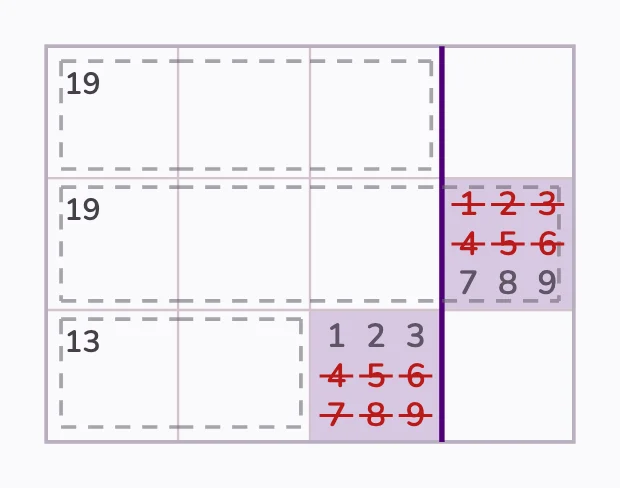
When cages cover a box except for one cell, and one cage also pokes out by a single cell, the box total links the two loose cells. These cages add up to 19 + 19 + 13 = 51 — six more than the box's 45 — so the cell sticking out is exactly 6 larger than the uncovered cell inside. The inside cell is 1, 2 or 3, and the outside cell 7, 8 or 9.
Killer sudoku cage combinations
Most of killer solving is pattern recall: seeing 17 in a two-cell cage and knowing instantly it is {8,9}. The tables below list every cage sum from two to five cells and the digit sets that can produce it. Rows marked with a dot have exactly one combination — those are the cages to fill first.
The cages that solve themselves
Sixteen sums across all cage sizes admit only one set of digits. Learn these and you will always have an opening move:
- 2 cells:
3=12 ·4=13 ·16=79 ·17=89 - 3 cells:
6=123 ·7=124 ·23=689 ·24=789 - 4 cells:
10=1234 ·11=1235 ·29=5789 ·30=6789 - 5 cells:
15=12345 ·16=12346 ·34=46789 ·35=56789
The pattern is symmetric: the two lowest and two highest sums of every cage size are always unique, because there is only one way to pack the smallest — or largest — available digits.
2-cell cages
| Sum | Possible combinations |
|---|---|
| 3 | 12 |
| 4 | 13 |
| 5 | 14 23 |
| 6 | 15 24 |
| 7 | 16 25 34 |
| 8 | 17 26 35 |
| 9 | 18 27 36 45 |
| 10 | 19 28 37 46 |
| 11 | 29 38 47 56 |
| 12 | 39 48 57 |
| 13 | 49 58 67 |
| 14 | 59 68 |
| 15 | 69 78 |
| 16 | 79 |
| 17 | 89 |
3-cell cages
| Sum | Possible combinations |
|---|---|
| 6 | 123 |
| 7 | 124 |
| 8 | 125 134 |
| 9 | 126 135 234 |
| 10 | 127 136 145 235 |
| 11 | 128 137 146 236 245 |
| 12 | 129 138 147 156 237 246 345 |
| 13 | 139 148 157 238 247 256 346 |
| 14 | 149 158 167 239 248 257 347 356 |
| 15 | 159 168 249 258 267 348 357 456 |
| 16 | 169 178 259 268 349 358 367 457 |
| 17 | 179 269 278 359 368 458 467 |
| 18 | 189 279 369 378 459 468 567 |
| 19 | 289 379 469 478 568 |
| 20 | 389 479 569 578 |
| 21 | 489 579 678 |
| 22 | 589 679 |
| 23 | 689 |
| 24 | 789 |
4-cell cages
| Sum | Possible combinations |
|---|---|
| 10 | 1234 |
| 11 | 1235 |
| 12 | 1236 1245 |
| 13 | 1237 1246 1345 |
| 14 | 1238 1247 1256 1346 2345 |
| 15 | 1239 1248 1257 1347 1356 2346 |
| 16 | 1249 1258 1267 1348 1357 1456 2347 2356 |
| 17 | 1259 1268 1349 1358 1367 1457 2348 2357 2456 |
| 18 | 1269 1278 1359 1368 1458 1467 2349 2358 2367 2457 3456 |
| 19 | 1279 1369 1378 1459 1468 1567 2359 2368 2458 2467 3457 |
| 20 | 1289 1379 1469 1478 1568 2369 2378 2459 2468 2567 3458 3467 |
| 21 | 1389 1479 1569 1578 2379 2469 2478 2568 3459 3468 3567 |
| 22 | 1489 1579 1678 2389 2479 2569 2578 3469 3478 3568 4567 |
| 23 | 1589 1679 2489 2579 2678 3479 3569 3578 4568 |
| 24 | 1689 2589 2679 3489 3579 3678 4569 4578 |
| 25 | 1789 2689 3589 3679 4579 4678 |
| 26 | 2789 3689 4589 4679 5678 |
| 27 | 3789 4689 5679 |
| 28 | 4789 5689 |
| 29 | 5789 |
| 30 | 6789 |
5-cell cages
| Sum | Possible combinations |
|---|---|
| 15 | 12345 |
| 16 | 12346 |
| 17 | 12347 12356 |
| 18 | 12348 12357 12456 |
| 19 | 12349 12358 12367 12457 13456 |
| 20 | 12359 12368 12458 12467 13457 23456 |
| 21 | 12369 12378 12459 12468 12567 13458 13467 23457 |
| 22 | 12379 12469 12478 12568 13459 13468 13567 23458 23467 |
| 23 | 12389 12479 12569 12578 13469 13478 13568 14567 23459 23468 23567 |
| 24 | 12489 12579 12678 13479 13569 13578 14568 23469 23478 23568 24567 |
| 25 | 12589 12679 13489 13579 13678 14569 14578 23479 23569 23578 24568 34567 |
| 26 | 12689 13589 13679 14579 14678 23489 23579 23678 24569 24578 34568 |
| 27 | 12789 13689 14589 14679 15678 23589 23679 24579 24678 34569 34578 |
| 28 | 13789 14689 15679 23689 24589 24679 25678 34579 34678 |
| 29 | 14789 15689 23789 24689 25679 34589 34679 35678 |
| 30 | 15789 24789 25689 34689 35679 45678 |
| 31 | 16789 25789 34789 35689 45679 |
| 32 | 26789 35789 45689 |
| 33 | 36789 45789 |
| 34 | 46789 |
| 35 | 56789 |
Cages of six cells or more are easiest to read backwards: a 6-cell cage summing to S uses the same digits as a 3-cell cage summing to 45 − S, just inverted. The same trick turns a 7-cell cage into a 2-cell lookup.
On 4×4 and 6×6 boards
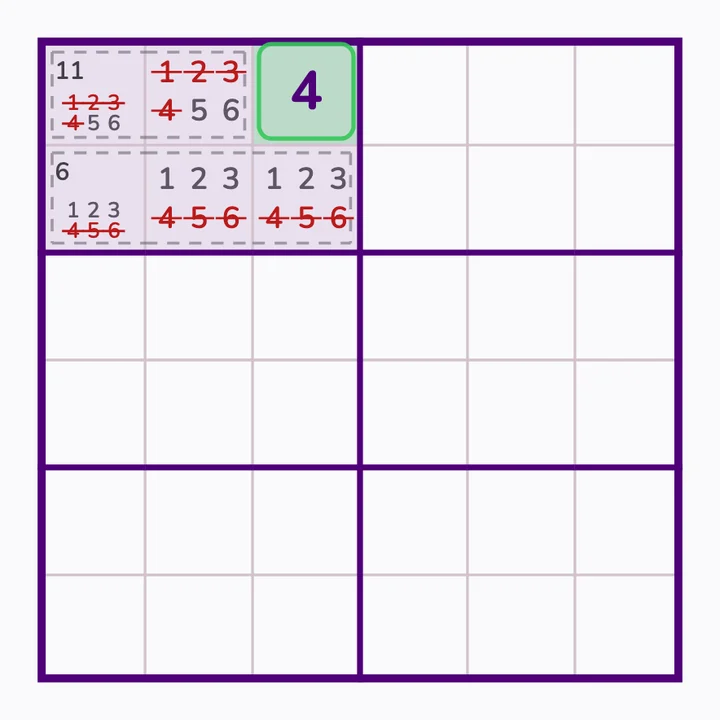
Small boards shrink the arithmetic. A row, column or box adds up to 10 on a 4×4 board (1+2+3+4) and 21 on a 6×6 board (1+…+6), so the 45 rule becomes the 10 rule and the 21 rule. Cage combinations also tighten because the digits stop at 4 or 6: a two-cell 11 on a 6×6 board can only be {5,6}, and on a 4×4 board every three-cell cage has exactly one combination.
| Board | Cage | Sums with only one combination |
|---|---|---|
| 4×4 | 2 cells | 3: {1,2} · 4: {1,3} · 6: {2,4} · 7: {3,4} |
| 4×4 | 3 cells | 6: {1,2,3} · 7: {1,2,4} · 8: {1,3,4} · 9: {2,3,4} |
| 6×6 | 2 cells | 3: {1,2} · 4: {1,3} · 10: {4,6} · 11: {5,6} |
| 6×6 | 3 cells | 6: {1,2,3} · 7: {1,2,4} · 14: {3,5,6} · 15: {4,5,6} |
| 6×6 | 4 cells | 10: {1,2,3,4} · 11: {1,2,3,5} · 17: {2,4,5,6} · 18: {3,4,5,6} |
| 6×6 | 5 cells | 15: {1,2,3,4,5} · 16: {1,2,3,4,6} · 17: {1,2,3,5,6} · 18: {1,2,4,5,6} · 19: {1,3,4,5,6} · 20: {2,3,4,5,6} |
Try one from the catalog
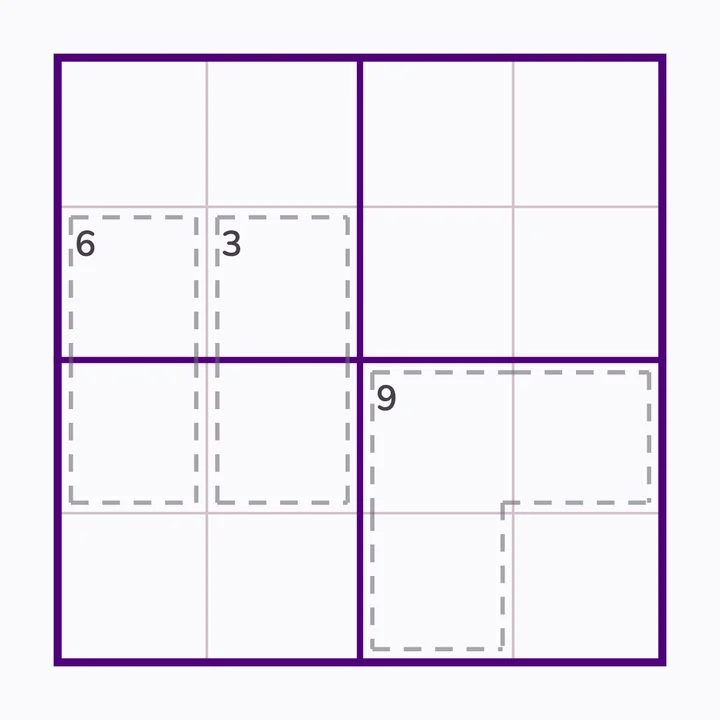
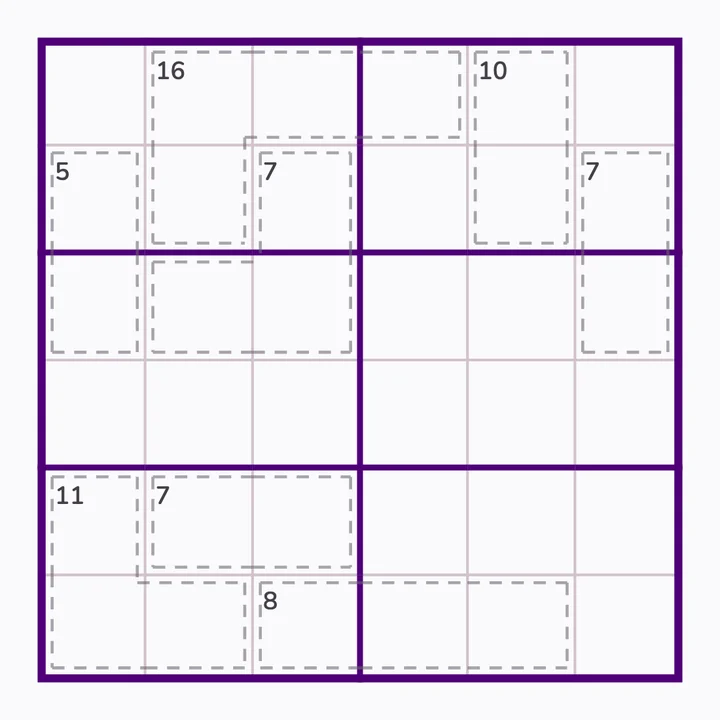
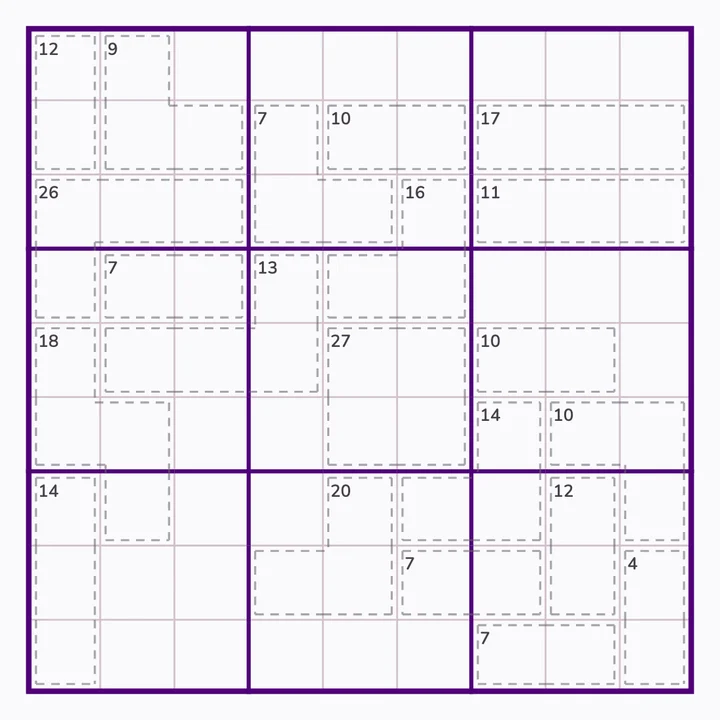
Real VariantDoku puzzles with this rule. Each one opens in the app.
Frequently asked questions
Do digits repeat inside a killer cage?
No. A digit can appear at most once per cage, on top of the usual row, column, and box constraints.
What is the 45 rule in killer sudoku?
Each row, column, and box contains 1–9, which sums to 45. Comparing cage totals against 45 lets you deduce leftover cells.
Which killer sudoku cages have only one possible combination?
Sixteen of them. For each cage size, the two smallest and two largest sums are forced: 3 and 4 (and 16, 17) in a two-cell cage, 6 and 7 (and 23, 24) in a three-cell cage, 10 and 11 (and 29, 30) in a four-cell cage, and 15 and 16 (and 34, 35) in a five-cell cage.
How do you play killer sudoku?
Fill the grid so every row, column and 3×3 box holds 1–9 exactly once, and every dotted cage adds up to its printed total without repeating a digit inside the cage. Killer grids usually start with few or no given digits — the cage sums are the clues.
Is killer sudoku harder than normal sudoku?
It adds an arithmetic layer, but the cage sums also give extra information — many solvers find well-set killers more satisfying than classic grids.
Play Killer Sudoku in VariantDoku
VariantDoku has a logic-checked catalog of Killer Sudoku and dozens of other variants on 4×4, 6×6 and 9×9 boards, with new 4×4 and 6×6 dailies every day. Free on iPhone, iPad and Android — no ads, no trackers.